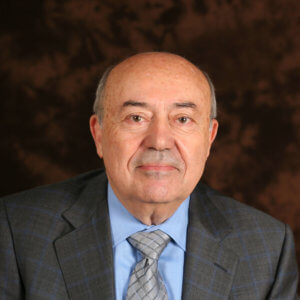
Andrew Viterbi is true pioneer in wireless communications. He is a co-founder of Qualcomm and the Linkabit Corporation, created the Viterbi Algorithm, and has been a professor of electrical engineering at UCLA and UC San Diego. He was born Andrea Giacomo Viterbi in Bergamo, Italy in 1935, and settled in Boston with his parents after emigrating to the U.S. two years before World War II. Andrew received his BS and MS from MIT in 1957 and subsequently worked at Raytheon and later at Jet Propulsion Laboratory where he worked on telemetry for unmanned space missions. While working, he simultaneously earned his PhD in digital communications from USC in 1963.
In the late 1960s, Dr. Viterbi created the Viterbi Algorithm, which decodes digital transmissions while suppressing radio interference and noise. He met Irwin Jacobs and along with Leonard Kleinrock they founded Linkabit Corporation in 1968. The company supplied software for government computers using the Viterbi Algorithm and provided technology for defense communications satellites. Dr. Viterbi and his Linkabit associates developed a breakthrough computer, which used many chips but referred to it as a “microprocessor”. Today, the Viterbi Algorithm is used in all four international standards for digital cellular telephones, as well as in data terminals, digital satellite broadcast receivers and deep space telemetry.
In 1985, to provide R&D for the wireless telecommunications market, Dr Viterbi, along with Irwin Jacobs and others, co-founded Qualcomm. Using his knowledge of spread spectrum technology Dr. Viterbi and his colleagues devised a new transmission technology for cellular phones — CDMA (Code Division Multiple Access) which would provide simultaneous access to a multitude of users with less interference and greater security for voice and data. Pacific Telesis, Motorola and AT&T invested in the experimental CDMA technology. By 2000, there were CDMA supported cell phones worldwide and CDMA became the predominant cell phone standard.
Dr. Viterbi has received numerous awards and accolades for his technological contributions and impressive career. He was inducted into the National Academy of Engineering in 1978, the National Academy of Sciences in 1996, the Wireless Hall of Fame in 2000, and the National Inventors Hall of Fame in 2013. Dr. Viterbi was awarded the 1990 Marconi Prize, the Benjamin Franklin Medal in Electrical Engineering in 2005, and the 2007 National Medal of Science from the President of the United States. In 2010 he received the IEEE Medal of Honor, and is also a Life Fellow of the IEEE. In 2017, Dr. Viterbi and Dr. Irwin Jacobs received the IEEE Milestone award for developing their CDMA and spread spectrum technology that still drives the mobile industry today. In 2000, Dr. Viterbi and his daughter, Dr. Audrey Viterbi launched the Viterbi Group, LLC., a venture capital company. In March 2004, USC dedicated the Viterbi School of Engineering in his honor.