Craig Snyder started his career at 21, climbing towers to pay his way through college. More than three decades later, he is the Chairman and Founder of VIKOR Teleconstruction, a co-founder of NATE, a former chairman of the TIA-222 standard-writing committee, and a 2026 Wireless Hall of Fame inductee. But what defines Craig isn’t the titles, it’s what he did with the moments that tested him. From witnessing a catastrophic tower collapse that launched an industry-wide safety reckoning, to testifying before the U.S. Senate on the advancement of 5G, Craig has spent his career doing one thing: elevating the industry for the betterment of everyone. We sat down with him to trace that journey.
WHF: You started climbing towers at 21 to pay your way through college. What did that experience teach you that you couldn’t have learned any other way?
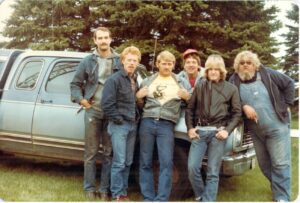
1984 Suicide Squad – Craig Synder in the red hat
Craig: Grit! Climbing towers is not for the faint of heart — it is hard work. Daring work. I’ve never been afraid of risk, but it taught me to respect the risks inherent with heights. It also taught me the importance of the team. I worked with a small group of friends who affectionately named ourselves the “Suicide Squad” — maybe not appropriate by today’s standards, but it symbolized our friendship, our bond, and our fearlessness. Most importantly, it taught me the trade from the ground level up, so that when I decided this would be my career and my entrepreneurial path, I knew the work as well as I knew the business side, which my classes at school were helping me learn at the same time.
WHF: At what point did you shift from doing the work to feeling responsible for how the whole industry was doing it?
Craig: I started feeling that shift around 1991 when a tower we were working on collapsed due to underground corrosion. My first responsibility was to my friends and colleagues who were injured, but then I realized many other climbers were at risk. That pushed me toward the Telecommunications Industry Association (TIA) and onto committee TIA-222, the consensus standard-writing body for the design and maintenance of towers.
Later, in 1994, I started wondering why our industry didn’t have its own tower services association. That’s when a peer of mine, Bill Carlson, asked if I wanted to join him in forming one. I was surprised, I had been having the same thoughts. I would eventually put my vision into a statement I hold dear to this day: “To Elevate the Industry for the Betterment of Everyone.” Not just the climbers, not just my company, not just our customers — but even my competitors.
WHF: Anchor Guard was born out of a defining moment in wireless history. Can you take us back to the anchor failure you witnessed, what it revealed about a systemic gap in the industry, and how that experience ultimately influenced not just your company but the entire industry’s approach to tower anchor protection?
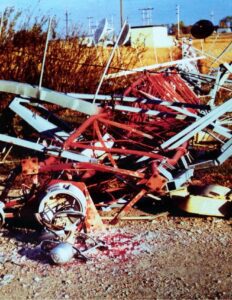
1990 Langdon, ND 350-foot tower failure due to underground corrosion
Craig: It was September 25, 1990. My company consisted of three men and a truck. We were inspecting towers for a regional cable TV company — a 350-foot guyed tower in Langdon, ND. We had just completed a “plumb and tension” procedure where you straighten the tower vertically and tighten guy wires to TIA-222 specifications. I started feeling a little low blood sugar — I’m not diabetic — and asked my two colleagues, Bart Roberts, my business partner, and Eric Snyder, my brother, if they would climb without me that day. They agreed. They began climbing while I went to inspect a particular anchor where soil had built up around the anchor fan plate. I was digging down on that anchor.
All at once I heard a sickening pop followed by a whoosh. The guy anchor had rusted almost completely in two, roughly seven feet below grade. Between the extra tension we had placed on the guy wires and the movement caused by the men climbing, the anchor failed — and the tower was falling.
I was emotionally sick. I literally fell to the ground as the men did the same from the collapsing tower. But then something inside me said to get up and go to their aid. As I slowly arose, the voice spoke more forcefully: Run. Which I did.
They were both seriously injured — Bart more than Eric. I prayed over both of them for a miracle. A miracle that was honored, as they both survived a 180-foot fall. A very low probability.
After a few weeks of great difficulty, my mind turned more and more toward what had caused that anchor to rust through as it had. I wondered if it was a one-off or a greater problem across the industry. I began studying underground corrosion, turning to the pipeline industry and a national association for resources.
I took the problem to TIA-222. The committee members were alarmed and asked me to return with more information at their next meeting. I ended up joining the committee, and they later invited me to serve as chairman — which I did from 1998 to 2006, presiding over two major standard revisions: TIA 222-D to E, and E to F.
I sort of expected someone smarter than me to come up with a solution. But no one was taking that initiative, so I worked one up myself with the help of others. We called it “AnchorGuard — Corrosion Control System for Guy Anchors.” We began offering it publicly around 1994 and still sell hundreds of systems each year — tens of thousands since it first went to market.
But it was never meant to be a for-profit business. It was a solution to elevate the industry for the betterment of everyone. I liked to call it “fall protection for the tower” — a play on the need for climber fall protection.
WHF: You chaired the TIA 222 committee and oversaw two major standard revisions. What’s the hardest part of building consensus on safety when everyone at the table has different incentives?
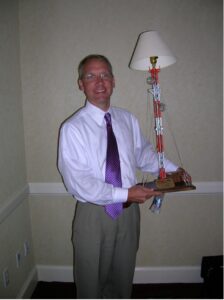
2006 Craig Receiving Award When Stepping Down as TIA-222 Committee Chair
Craig: The key is building unity — listening to ideas, giving everyone a voice, being empathetic. But also knowing when to lead and move things forward. I was good at identifying the key voices in the room and bringing them onto a subcommittee I formed — I called it the editorial committee. These were individuals everyone respected, and the broader group was comfortable letting them make decisions between meetings. The editorial committee and I would meet several times between open sessions to work through the harder elements of writing the standard, then bring the draft back to the full committee to be polished with input from other stakeholders.
I grew to love those guys on the committee. I was pretty much the only non-engineer in the room, but everyone still respected me.
WHF: VIKOR has grown across the Central Plains, the Mountain States, and the Southwest. How do you maintain a safety culture at that scale? what does it actually look like on the ground?
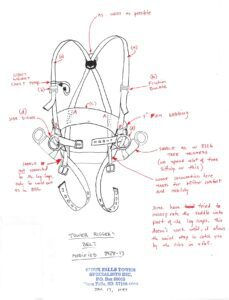
1997 Concept Drawing of First Tower Climbers Harness by Todd Thorin
Craig: Culture is the key word in this question. Everything starts with a good culture. If you have one, it becomes very easy to inspire and enforce safety, because everyone believes in it and becomes their brother’s keeper. But it also takes investment. I have always felt strongly that every dollar spent on safety pays dividends over time. So even as a very small company, I brought on a full-time safety director who had started his career as a climber. When the industry didn’t have a full-body harness for the tower services sector, my safety director and I invented one.
I believe in empowerment. Any member of the team — from beginner on up — has the ability to stop a job if their gut tells them something isn’t right. We rely on field experience to work through safety challenges, and we put leaders in our safety department who came from the field and whom everyone respects. People on the ground are encouraged to report incidents and close calls, and we highlight those in all-hands Zoom meetings every week.
WHF: You co-founded NATE in 1996 with three other people in a room in Dallas. What problem were you trying to solve, and did it turn out to be the problem you thought it was?
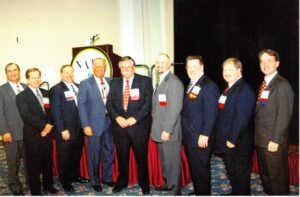
1995 — NATE Original Board of Directors. Craig Snyder, Secretary/Treasurer (far right), alongside co-founder Bill Carlson, Wireless Hall of Fame inductee (2014), at center
Craig: The two problems we were trying to solve were: 1) establishing a unified voice to help guide the Occupational Safety and Health Administration (OSHA) to a better understanding of our industry. At the time, they were citing companies for violations that were simply inherent to tower climbing — and 2) creating an organization where tower contractors could unite around common challenges and support each other with solutions, rather than going it alone as had been the case up to that point.
We were a “cowboy” industry before that. We didn’t like rules and weren’t afraid of risk. We distrusted our competition and didn’t like government overreach. We worried that the gathering in Dallas would break out into arguments and we’d end up with the opposite of unity. But that was not the case at all. Everyone was hungry for togetherness over a common cause. The industry drank it up — we had over 60 contractors join the association in the first year.
WHF: KOR Training started in 2018. Why did you feel the industry still needed something that didn’t exist yet? what gap were you filling
Craig: To be honest, KOR Training came to be more out of necessity than vision — unlike most of my other companies. Our customers didn’t want to certify us without third-party training oversight, even though VIKOR has pretty much written the book on safety and training. But they would certify us if a third-party training company signed off. So we formed our own. We don’t offer KOR Training services to outside companies, with the exception of fire and rescue organizations.
KOR is a play on VIKOR. VIKOR has a dictionary definition, but I like to think of it as two parts: VIK — short for Viking, meaning conquerors, explorers, rugged individualists, travelers — and KOR, meaning hard core, tough, durable.
WHF: You’ve taken senators, congressmen, and an FCC Chair up towers. What do you want them to understand by the time they come back down?
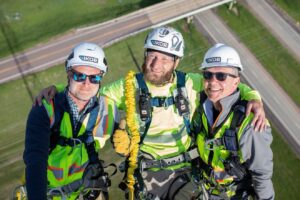
Brendan Carr, Brandon Foster, Safety Director, Craig Snyder
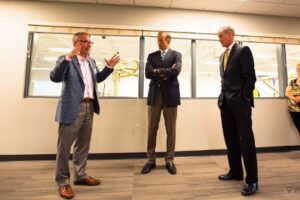
Craig Snyder, Majority Leader John Thune, Former Governor Dennis Daugaard
Craig: We want them to feel what it’s like to be at height, to get just a small taste of what the men who maintain towers day in and day out experience up there in the wind and weather. We want them to gain a deeper appreciation for this unique trade that very few will ever experience but that most depend on every time they pull a phone out of their pocket or purse. We want them to associate five bars of coverage with a person who dons on a harness and climbs to heights demanding a highly technical, cross-disciplinary skill set. We hope they leave as advocates for the positive changes our industry is seeking.
And in the process, they earn a little political capital for having the nerve to not just sit behind a lectern, but to do something that a very small percentage of the public would ever attempt.
WHF: You’ve built multiple companies without outside capital, trained executives who went on to start competing businesses, and are now bringing your sons into the work. What does legacy mean to you in this industry?

Snyder Family – Three Generations
Craig: My businesses and this industry have almost become like another child to me. I try not to think about “legacy” since it can put your mind in a prideful place. But I do have a deep passion for the well-being of everything I’ve worked toward: elevating the industry for the betterment of everyone.
I like knowing I didn’t need to give up part of my company to outside investors, that I was able to build it organically on proven success and the profits that hard work generated. I like knowing that the colleagues who left VIKOR to start their own enterprises — as much as that hurt at the time — were able to take what they learned here and use it to elevate the industry and provide for their own families. And now, to have my sons and other close friends and executives at my side is extremely rewarding. I love the idea that VIKOR can live on for another generation.
I don’t seek the honor or praise of my peers. But when it comes — as it has with my induction into the 2026 Wireless Hall of Fame — it is deeply gratifying. I am humbled and honored that something I’ve done has made a difference.
Craig Snyder will be officially inducted into the Wireless Hall of Fame at this year’s Awards Dinner, to be held on Monday, October 5, 2026, at the Ritz-Carlton, Pentagon City in the Washington, D.C. metro area. His company, VIKOR Teleconstruction, is a proud sponsor of the Wireless History Foundation.